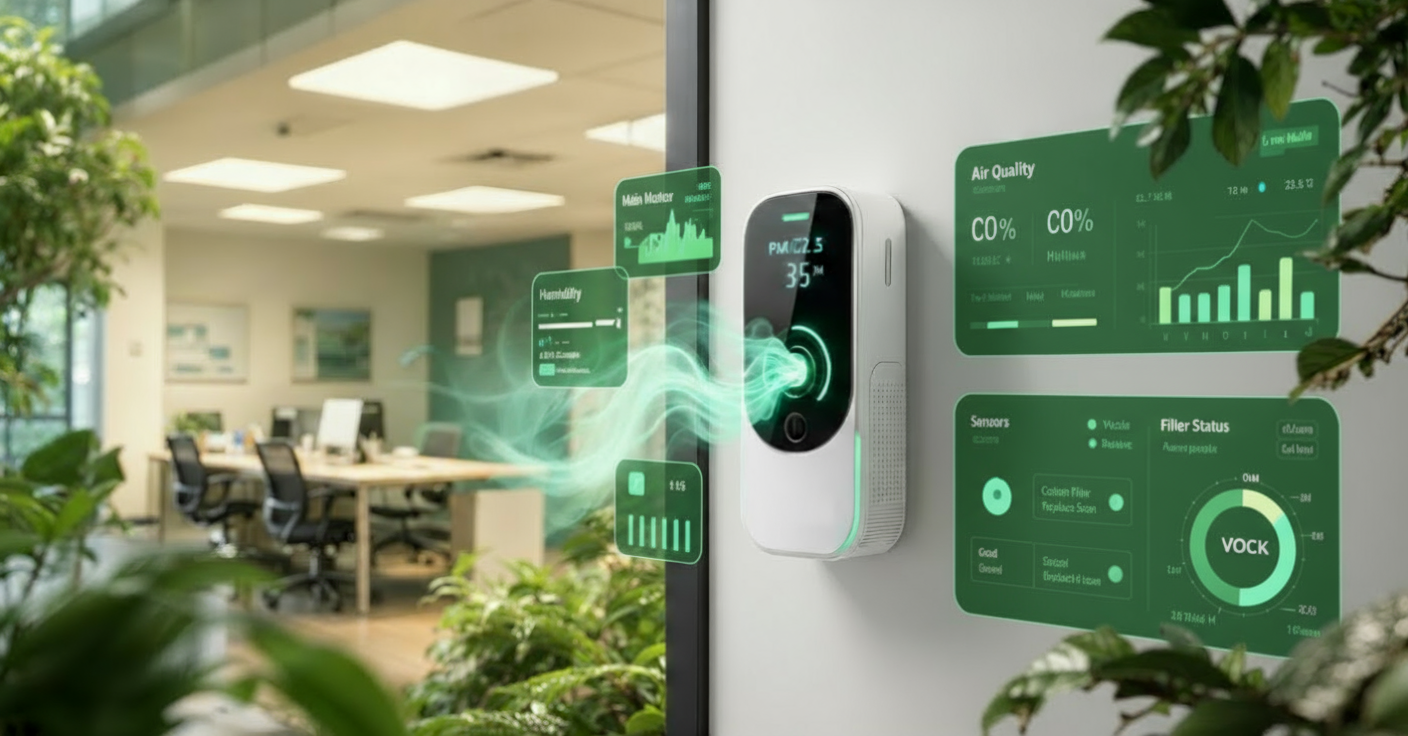


Indoor Air Quality (IAQ) has always been crucial, but the next five years will see IAQ evolve from just a metric into a driving force for healthier environments, operational efficiency, and regulatory compliance. As we approach 2026 and beyond, air quality monitoring will no longer be about just tracking pollutants—it will be about actionable insights that improve health, productivity, and sustainability across a wide range of sectors, including schools, hospitals, offices, and industrial environments.
Let’s explore the key trends shaping the future of IAQ, powered by advanced analytics and AI, and understand how businesses and organizations can stay ahead in the rapidly changing landscape.
1) The Power of Predictive IAQ Analytics
In the next five years, IAQ monitoring will evolve significantly with the integration of predictive analytics. Instead of simply reporting poor air quality after it’s happened, systems will begin forecasting air quality trends. Imagine an office where the system can predict rising CO₂ levels based on the number of people in the room or alert a school administrator about a potential mold risk before it spreads.
By 2031, IAQ analytics will be able to:
- Predict spikes in pollutants based on occupancy and HVAC performance
- Anticipate the need for maintenance before filters get clogged
- Provide real-time insights to facility managers on how to maintain optimal indoor conditions
The future will be less about reacting to poor IAQ and more about acting before problems arise.
2) Indoor Air Quality as a Key Driver for Employee and Student Well-being
As businesses and educational institutions continue to prioritize health and well-being, IAQ will play a significant role. By 2026, more companies will recognize that poor air quality directly impacts employee productivity, focus, and even long-term health. Schools will see IAQ as a critical factor for student performance, leading to better learning environments. Hospitals will integrate IAQ monitoring into infection control strategies, ensuring that patients are always in safe, sanitized, and comfortable spaces.
Expect to see:
- Healthier environments tied directly to productivity and learning outcomes
- A greater emphasis on air quality wellness programs in corporate offices, healthcare facilities, and educational institutions
- Public awareness around clean air standards in every workplace
3) The Role of AI and Machine Learning in IAQ Optimization
AI and machine learning will play a massive role in automating and optimizing IAQ systems. By 2031, we’ll see smart systems that adapt and learn based on environmental changes and human activity patterns.
For example:
- Machine learning algorithms will be able to detect subtle shifts in air quality before they reach critical thresholds.
- AI-driven automation will control HVAC systems more efficiently, only increasing air circulation when necessary to save energy while maintaining optimal air quality.
By leveraging these technologies, IAQ systems will go from static monitors to dynamic decision-makers, optimizing energy use while maintaining safe indoor environments.
4) The Integration of IAQ Data with Other Building Systems
One of the most exciting trends over the next five years is the integration of IAQ data with broader building management systems (BMS). By 2031, air quality monitoring will be fully connected with other environmental and operational data points such as lighting, heating, cooling, and security systems. This integration will enable buildings to become smarter, making real-time adjustments to keep people safe, comfortable, and productive.
Key benefits will include:
- Real-time building optimization where IAQ controls adjust based on occupancy, weather, and other factors.
- Enhanced energy efficiency: IAQ systems will automatically adjust based on building usage, optimizing heating, cooling, and ventilation to maintain a balance between air quality and energy consumption.
5) Data-Driven Compliance and Sustainability
As governments and regulatory bodies become more focused on sustainability, organizations will need to maintain strict IAQ compliance. By 2026, IAQ will be an important part of ESG (Environmental, Social, Governance) reporting, and organizations will be expected to track and report their air quality data in real-time.
IAQ analytics will help organizations:
- Automatically track compliance with air quality regulations and building codes
- Generate reports for regulatory authorities with minimal effort
- Enable predictive maintenance to avoid non-compliance penalties
6) Multi-Site and Real-Time IAQ Monitoring for Global Operations
As businesses grow globally, managing IAQ across multiple locations will become a critical challenge. Companies with offices, schools, or healthcare facilities in multiple cities will demand centralized, real-time IAQ data, giving them the ability to monitor and adjust environments on a global scale. By 2031, multi-site dashboards will become the norm, helping organizations:
- Compare air quality across regions, identify trends, and act on localized issues
- Centralize reporting for compliance and sustainability audits
- Ensure uniform health and safety standards across all locations
7) AI-Driven IAQ For High-Risk Environments
For high-risk industries like oil and gas, manufacturing, and industrial operations, the next five years will be all about advanced IAQ monitoring systems that go beyond general pollutants to include specialized industrial contaminants, VOCs, particulate matter, and gases. These industries will increasingly rely on AI-driven IAQ systems that can:
- Detect dangerous gas leaks or hazardous particles before they escalate into serious problems
- Monitor environmental stressors related to machinery, chemical usage, or operational conditions
- Automate responses to ensure worker safety and minimize health risks
By 2031, IAQ will be an integrated part of environmental health and safety in these industries.
8) A New Era for Indoor Air Quality in Homes and Buildings
While much of the focus has been on larger institutions like schools, offices, and hospitals, residential buildings will see a significant transformation in IAQ by 2031. Smart homes will use IAQ sensors and analytics to maintain a perfect balance between indoor air quality, comfort, and energy efficiency.
We’ll see:
- Homes with advanced IAQ systems that automatically adjust based on real-time environmental data.
- Personalized air quality solutions for people with allergies, asthma, and other respiratory conditions.

Why SmartEco is Important for the Future of IAQ
As IAQ becomes a crucial factor in creating healthy, productive environments, SmartEco is leading the charge with innovative solutions designed to help businesses and institutions optimize air quality across a variety of settings.
Key Features of SmartEco
Comprehensive Air Quality Monitoring
SmartEco provides real-time monitoring for a wide range of indoor air quality parameters including CO₂, PM1, PM2.5, VOCs, CO, NO₂, O₃, SO₂, Virus Index, Mold Index, and AQI, ensuring safe and healthy air conditions across environments like schools, hospitals, offices, and industrial spaces.
Real-Time Data Analytics and Insights
SmartEco’s system integrates advanced analytics that not only monitors air quality but also provides actionable insights, offering recommendations to improve air conditions and optimize HVAC performance.
Predictive Analytics for Better Proactive Management
Leveraging AI and machine learning, SmartEco’s system can predict air quality trends, providing proactive alerts for maintenance or changes in ventilation before issues arise.
Seamless Integration with Existing Building Systems
SmartEco easily integrates with existing building management systems (BMS) and HVAC controls, allowing for automated adjustments and optimizing energy use while maintaining IAQ.
Cloud-Based Platform for Multi-Site Monitoring
SmartEco supports centralized management for multiple locations, providing real-time air quality data, actionable insights, and compliance reports for businesses and institutions across the globe.
User-Friendly Interface
With a simple, intuitive dashboard, SmartEco makes it easy for facility managers, school administrators, and healthcare providers to access real-time air quality data, receive alerts, and take action.
Compliance & Sustainability Reporting
SmartEco offers automated compliance reporting, supporting organizations in meeting environmental and health regulations and contributing to sustainability initiatives.
The Future of IAQ: A Healthier, Smarter Tomorrow with SmartEco
The future of IAQ lies in data-driven decision-making, predictive insights, and smarter buildings. With the integration of advanced analytics, AI, and cloud technology, SmartEco is revolutionizing how we manage and improve indoor air quality across a wide range of industries. As the world continues to focus on environmental health, SmartEco is here to ensure that the next generation of indoor spaces is not just smarter, but healthier, more productive, and sustainable.
By adopting SmartEco, organizations can ensure safe environments, increase employee and student productivity, and meet regulatory compliance while supporting their sustainability goals. The future of IAQ is bright, and with SmartEco, you can lead the way toward cleaner, healthier indoor environments for all.