

Introduction: The Rising Stakes for Indoor Air Quality
In 2025, buildings — whether schools, offices, hospitals, or workplaces — are not just infrastructure. They are ecosystems where people spend most of their time: children learning, staff working, patients healing. Historically, ventilation design has relied on static models: fixed schedules, mechanical or natural airflow assumptions, and broad-stroke rules (e.g., “open windows,” “HVAC runtime for X hours/day”).
But as we navigate evolving health standards, increased urban pollution, and growing awareness of indoor pollutants, these traditional ventilation models are showing their limitations.
That’s where data — continuous, real‑time, granular — is becoming the new baseline. And companies like SmartEco are driving this shift.
The Limitations of Traditional Ventilation (And Why They Are Failing)
Static Ventilation ≠ Dynamic Occupancy or Pollution Realities
Traditional ventilation systems — natural or mechanical — assume a fixed airflow based on building design or occupancy norms. But real-world indoor air quality (IAQ) depends on many variables: number of occupants, their activities, external pollution infiltration, indoor pollutant sources (e.g. VOCs from furniture/cleaning supplies), humidity, temperature, and more. Static ventilation cannot adapt to these dynamic conditions.
Energy vs. Health Trade‑off
Mechanical ventilation systems have often prioritized energy efficiency or thermal comfort, sometimes at the cost of IAQ. According to recent research, while advanced mechanical ventilation (e.g. demand‑controlled ventilation) can reduce energy usage significantly, balancing that with high IAQ remains challenging. In many buildings, especially older ones or retrofit spaces, system misuse (oversized ducts, poor maintenance, unoptimized airflow) can lead to poor pollutant removal, resulting in high CO₂ or particulate concentrations even during “ventilated” periods.
Lack of Feedback — “Set and Forget” Approach
Traditional ventilation systems are often configured once (during design or commissioning) and then left largely unattended. There’s minimal ongoing feedback about actual indoor air parameters (PM2.5, VOCs, CO₂, humidity, etc.). This static approach means problems go unnoticed — until air quality crosses a threshold, or complaints arise.
Inability to React to External Pressure
Pollution, Pandemics, Climate With rising urban air pollution, wildfire smoke, industrial emissions and increased awareness after global health crises (e.g. the COVID-19 pandemic), relying on outside air ventilation alone can backfire. Outdoor air might be more polluted than indoor air — making “open all dampers” a risky proposition.
Poor Fit for Sensitive Environments (Schools, ICUs, Offices)
Spaces with vulnerable occupants — children, patients, workers tied to productivity — need more stringent, adaptive IAQ controls. Traditional systems, lacking real‑time monitoring and adaptive ventilation based on pollutant load or occupancy, simply cannot guarantee the consistent air quality those spaces demand.

What Data‑Driven IAQ Predicts Instead — The Future of Ventilation
Real-Time Monitoring & Continuous Feedback Loops Are the New Norm
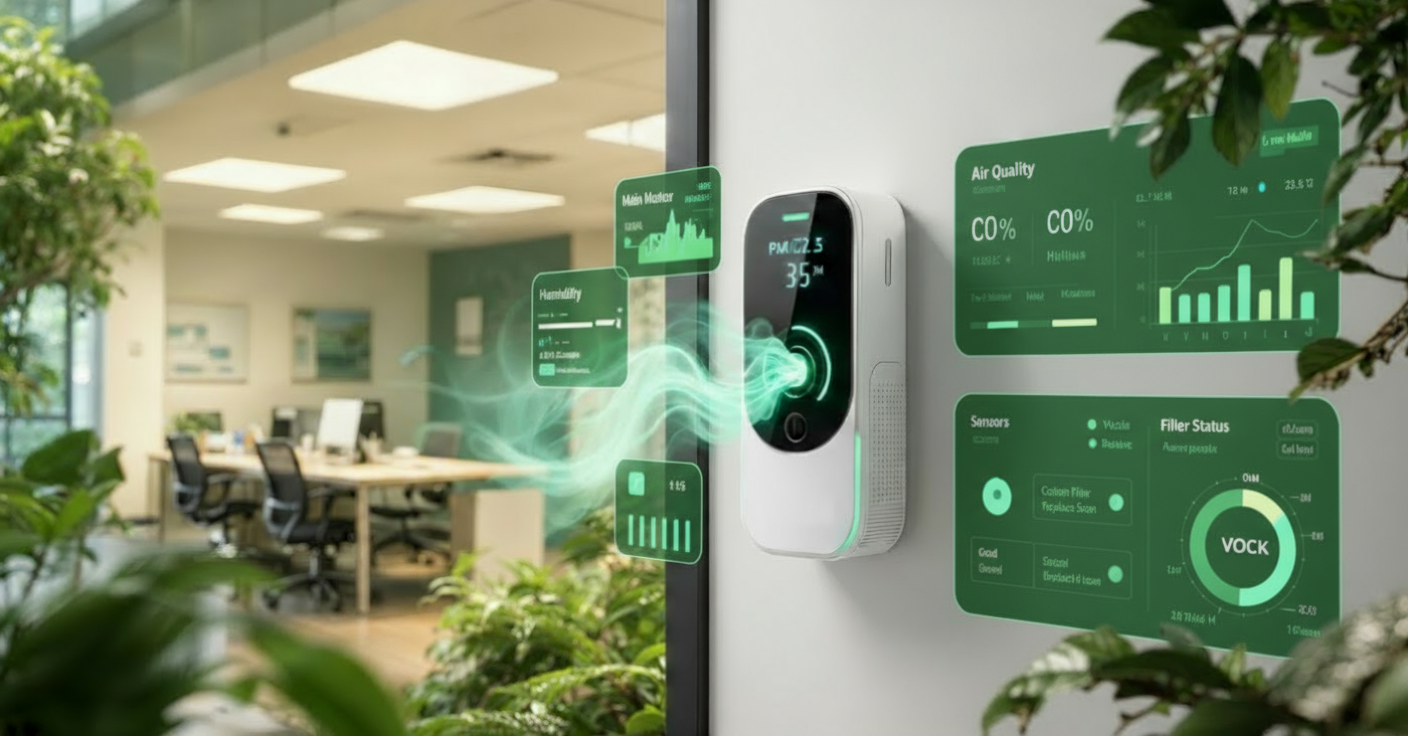
Thanks to advances in IoT, sensor technology, and cloud analytics, it’s now possible to continuously monitor indoor pollutant levels (PM2.5, VOCs, CO₂, humidity, PM10) rather than rely on periodic spot checks or fixed ventilation schedules.
This allows facility managers to see the real, dynamic air-quality profile of their indoor spaces at every moment — a far more reliable foundation than assumptions.
Adaptive Ventilation (Smart / Demand‑Controlled / Occupant‑Centric)
With data in hand, ventilation systems can shift from “set-and-forget” to adaptive models. Using real-time IAQ data and occupancy/behavioral insights, ventilation (or filtration) can ramp up when pollution or CO₂ rises — and scale back when air is already clean, optimizing energy and air quality simultaneously. This is at the heart of what building automation and occupant-centric controls aim for.
Integration with AI and Predictive Analytics for Proactive IAQ Management
Beyond just reacting in real time, data-driven IAQ platforms are increasingly integrating AI/ML to forecast air quality trends, anticipate pollutant spikes (due to occupancy, outdoor air pollution events, humidity swings), and preemptively adjust ventilation or filtration — before occupants breathe polluted air.
Balanced Approach — Health, Comfort & Energy Efficiency
Rather than choosing between energy savings or air quality, data-driven IAQ systems deliver both. By ventilating intelligently — only when needed — buildings can maintain high air quality without massive energy waste. Studies show demand-controlled ventilation can improve energy efficiency dramatically while maintaining acceptable CO₂ levels during most occupancy periods.
Data Transparency, Compliance & Certification Ready
For schools, hospitals, offices aiming for certifications like WELL Building Standard, LEED, Fitwel or RESET — real-time IAQ data makes compliance easier and credible. And for building owners/occupants, having transparent air-quality data builds trust, demonstrates commitment to well-being, and can improve property value.
SmartEco mission, features and values — real-time sensors, cloud analytics, BMS integration, modular scalability — align perfectly with this future. The future is not occasional ventilation checks, but continuous IAQ vigilance and dynamic control.
For Whom This Matters Most: Schools, Offices & Hospitals (Especially ICUs)
Schools and Learning Spaces:
Children are more vulnerable to poor air quality. Dynamic IAQ monitoring ensures pollutant levels are kept in check, supporting cognitive performance, reducing allergies and absenteeism.
Offices and Workplaces:
Productivity, focus, and employee wellness suffer under stale or polluted air. Data-driven ventilation ensures a healthier, more comfortable work environment — while optimizing energy bills.
Hospitals and ICUs:
Patients (often immunocompromised) require pristine air quality. Static ventilation can’t guarantee pollutant-free air or timely filtration. Real-time IAQ monitoring, adaptive systems, and data logging can significantly reduce infection risk and improve recovery outcomes.

Why 2025 is the Turning Point — And Why Old Models Will Collapse
External environmental pressures — urban pollution, climate change, seasonal air pollution spikes — make outside-air-only ventilation risky. Indoor spaces need intelligent filtration and monitoring instead of naive air exchange assumptions.
Building design and operation paradigms are shifting — energy efficiency, sustainability, occupant wellness, and smart building automation are no longer optional. Data-driven IAQ is now part of that shift.
The global IAQ monitoring market is expanding rapidly, with rising awareness of health impacts, regulatory pressure, and smart building adoption.
Health crises (pandemics, airborne diseases) and increased public awareness have raised the bar for indoor air safety — especially in hospitals, schools, and offices.
Given all these, by 2025, buildings relying solely on traditional ventilation models will fall short. They’ll be exposed — to health risks, regulatory scrutiny, occupant dissatisfaction, and inefficiency.
The Call to Action: Embrace Data — Trust, Monitor, Act
Stop assuming ventilation = safety
Start measuring actual indoor air quality — not just airflow or air changes per hour.
Deploy real‑time IAQ monitoring systems
(like SmartEco) — especially in critical spaces (classrooms, offices, ICUs).
Integrate IAQ data with BMS / HVAC systems
To enable smart, adaptive, responsive control, not rigid schedules.
Leverage analytics & historical data and Communicate & certify
To understand patterns, foresee potential IAQ issues, and optimize ventilation/filtration policies. use data to validate air quality, meet standards (WELL / LEED / Fitwel / RESET), and build occupant trust.
At SmartEco, we believe that monitoring air quality is just the first step. What matters is converting that data into actionable insights that safeguard health, boost comfort, and reduce energy consumption.
The future isn’t just ventilate more. It’s ventilate smartly, based on data. And that’s why traditional ventilation models will fail — not because they were bad — but because they’re static in a dynamic world.
Conclusion
SmartEco is leading the way in redefining how we manage indoor air quality. As traditional systems give way to smarter, more dynamic solutions, SmartEco ensures that buildings are prepared for the future — offering real-time monitoring, intelligent adjustments, and data-driven insights that protect occupant health, reduce costs, and support sustainability. For schools, hospitals, offices, and industrial spaces, SmartEco is the key to healthier, more efficient indoor environments.