

Based on new research from the Grantham Research Institute on Climate Change and the Environment, London School of Economics and Political Science (LSE):
Metcalfe, R. & Roth, S. (2025). Making the Invisible Visible: The Impact of Revealing Indoor Air Pollution on Behaviour and Welfare. Tackling indoor air pollution could save UK up to £40 billion a year.
The Invisible Threat in Our Homes and Workplaces
Most people associate air pollution with traffic congestion or industrial zones. Yet a ground-breaking study from the London School of Economics’ Grantham Research Institute on Climate Change and the Environment (LSE-GRI) has exposed a less visible but equally damaging problem: the air inside our homes, offices, and schools.
In their working paper, “Making the Invisible Visible: The Impact of Revealing Indoor Air Pollution on Behaviour and Welfare”, Professors Robert Metcalfe and Sefi Roth found that the average UK household is unknowingly breathing in air that is just as polluted as the outdoors — and sometimes worse.
Their research, which was later summarised in the Institute’s news article “Tackling indoor air pollution could save UK up to £40 billion a year”, goes beyond health impacts. It quantifies how poor indoor air quality (IAQ) silently drains the British economy through lost productivity, healthcare costs, and reduced wellbeing.
What the LSE Research Discovered
To understand how bad the problem is, the researchers installed real-time air-quality sensors in 258 homes across London, measuring concentrations of fine particulate matter (PM2.5) — microscopic particles that can penetrate deep into the lungs and bloodstream.

Indoor Air Is Just as Polluted as Outdoor Air
Across the study, the average indoor PM2.5 concentration was 10.5 micrograms per cubic metre (µg/m³) — almost identical to the outdoor average of 10.8 µg/m³. During evening hours (4 p.m.–11 p.m.), when cooking, heating, and cleaning are most common, indoor pollution actually exceeded outdoor levels, reaching around 14.6 µg/m³.
This means that even when people are inside — typically to escape poor outdoor air — they may still be inhaling harmful pollutants.
Most Pollution Comes from Inside
The study found that outdoor pollution levels were a poor predictor of indoor pollution. Instead, indoor air quality depends heavily on domestic behaviours and building conditions. Common culprits include:
- Cooking with gas or frying oils
- Burning candles or incense
- Cleaning sprays and aerosols
- Inadequate ventilation or sealed windows
- Smoking or passive smoke exposure
These are activities that occur daily in nearly every household or office, yet most people remain unaware of their cumulative impact on indoor air.
A Widening Inequality Gap
Another striking discovery by the LSE team was the strong socio-economic gradient in exposure. Households with lower incomes or living in older buildings experienced significantly higher indoor PM2.5 levels — sometimes 20% higher than wealthier counterparts.
This inequality reflects disparities in ventilation systems, building insulation, and access to information or technology that can monitor air quality. The research emphasises that indoor pollution is not just a health or environmental issue — it’s also a question of social justice.
Awareness Changes Behaviour
Perhaps the most encouraging result from the study is behavioural. When households were given real-time feedback about their indoor air quality through monitoring devices, they reduced pollution levels by:
- 17% overall, and34% during occupied hours (when people were home).
These improvements were achieved mainly through simple actions — opening windows at the right times, increasing ventilation, and reducing high-pollution activities.This finding underlines a powerful truth: visibility leads to action. When people can see what they’re breathing, they make better choices.n.
The Economic Cost: £40 Billion Lost Every Year
The LSE Grantham Institute’s follow-up analysis translated these health and behavioural findings into hard economics. According to their February 2025 news article, poor indoor air quality costs the UK up to £40 billion each year.
This staggering figure captures:
Increased healthcare spending, particularly for asthma, respiratory infections, heart disease, and allergies.
Lost productivity from worker absenteeism, fatigue, and reduced cognitive performance.
Lower learning outcomes in schools due to impaired concentration.
Premature deaths and welfare losses related to chronic exposure.
The researchers argue that even modest interventions — such as subsidising home air monitors or improving ventilation standards — would quickly pay for themselves many times over. Their conclusion is clear: cleaner indoor air is not just a health priority, it’s an economic necessity.
Why This Matters for Every Household and Business?
The LSE research highlights that indoor air pollution is both preventable and measurable. People can act once they know. Yet, without the right tools, the “invisible” nature of the problem means it often goes unnoticed.
This is where technology companies like Smarteco step in — bridging the gap between scientific insight and real-world solutions.
Smarteco: Turning LSE Insights into Smarter, Cleaner Spaces
At Smarteco, our purpose aligns directly with the findings from the London School of Economics’ Grantham Research Institute. Our smart air-quality systems are designed to make the invisible visible, empowering individuals and organisations to take control of their indoor environments.
Here’s how Smarteco’s products translate research into real-world impact:
Real-Time Air-Quality Monitoring
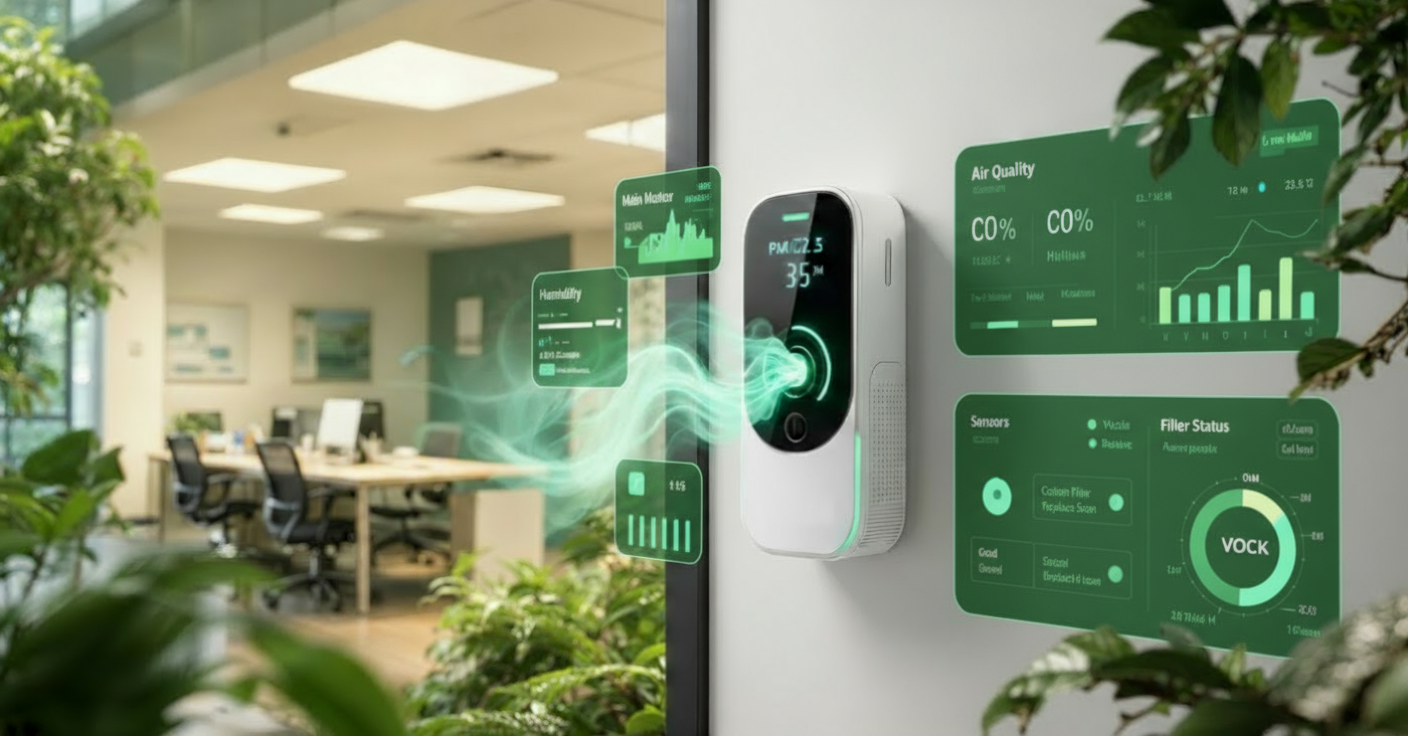
Just as in the LSE experiment, Smarteco uses advanced sensors to measure PM2.5, CO₂, volatile organic compounds (VOCs), temperature, and humidity — providing continuous, accurate data on indoor air conditions.
Users can see their air quality at a glance through our mobile app or wall display, enabling immediate awareness and action.
Intelligent Analytics and Automation
The LSE research showed that feedback reduces pollution. Smarteco takes this one step further with AI-powered analytics that automatically detect pollution patterns and adjust building systems — such as ventilation, filtration, or air-conditioning — in real time.
This closed-loop system ensures optimal air quality even when people aren’t paying attention.
Empowering Behavioural Change
By providing clear, easy-to-understand feedback, Smarteco encourages the same kind of behavioural responses observed in the LSE study — simple, everyday actions that make a measurable difference.
Our platform also issues gentle nudges: reminders to ventilate during cooking, alerts when air quality drops, and long-term trend reports that motivate sustainable habits.
Accessibility and Equity
The LSE Grantham Institute highlighted how low-income households face higher indoor pollution. Smarteco designs scalable, affordable solutions suitable for a wide range of users — from single flats to large corporate offices. We believe that clean air should not be a luxury.
Quantifiable Economic Benefits
Cleaner air improves employee performance, reduces sick leave, and creates healthier buildings. Smarteco’s clients often see measurable gains in wellbeing and efficiency — mirroring the £40 billion potential national savings estimated by the London School of Economics.
The Bigger Picture: From Awareness to Policy
The LSE’s findings carry important policy implications. Despite decades of focus on outdoor air pollution, people spend nearly 90% of their time indoors, where regulations and monitoring are minimal.
The Grantham Research Institute calls for integrating indoor air quality into national health, housing, and productivity strategies. For businesses and building owners, this research makes a strong case for proactive action — not just compliance.
By adopting smart technologies like Smarteco’s integrated air-quality management systems, organisations can lead the way in creating healthier workplaces, meeting sustainability goals, and contributing to national economic resilience.
A Shared Vision for a Healthier Future
The research by Professors Robert Metcalfe and Sefi Roth, published through the Grantham Research Institute at the London School of Economics, reveals a simple yet transformative message:
When people understand their indoor air, they change it — and when they change it, everyone benefits.
At Smarteco, we are proud to support this vision. By combining data, smart automation, and human insight, we help households and organisations reduce invisible pollutants, protect health, and enhance productivity.
Clean air is no longer a mystery — it’s measurable, manageable, and essential for a thriving economy.